

What if the crisis in learning is not about what we teach, or even how — but about whether students are being formed into agents of their own becoming?
There is a peculiar anxiety running through education policy right now. It surfaces in the hand-wringing over AI in classrooms, in literacy and numeracy benchmarks that refuse to lift, in the restless churn of pedagogical reform. Everyone agrees something is broken. Very few agree on what.
The dominant diagnosis oscillates between two poles. The first says the system is under-resourced — more teachers, more funding, more technology will close the gap. The second says the system is philosophically lost — too focused on outcomes, not enough on curiosity, wonder, the intrinsic joy of learning.
Both are partially right. Both miss the deeper fault line.
The crisis in modern education is not a knowledge deficit. It is an agency deficit. And no curriculum reform, no EdTech platform, no well-meaning wellbeing programme will address it until we are willing to name that clearly.
What agency actually means
Agency is not confidence. It is not resilience. It is not “growth mindset” — that well-worn phrase now stretched so thin it means almost nothing. Agency, in the fullest sense, is the capacity to act from an understanding of why you are acting. It is the integration of motive, intention, identity, and consequence into a coherent self that engages with the world on its own terms.
At BrainPrint, our framework makes a fundamental distinction that education seldom makes explicit: the difference between a person who responds to the world and one who authors it. Between adaptive behaviour and genuine self-direction. Between a student who learns to pass and one who learns because the question matters to them.
This is not an abstract philosophical distinction. It has measurable, observable expressions. It shows up in how people frame problems, in the questions they ask (or don’t), in the degree to which they locate causation inside or outside themselves. It shapes the entire texture of a learning life.
“We have built systems extraordinarily good at producing compliant learners. We are far less practiced at producing consequential ones.”
The structural irony of modern schooling
Here is the structural irony: the very mechanisms designed to drive educational outcomes — standardised assessment, learning objectives, success criteria, data-informed instruction — are, in their current form, systematically undermining the agency they claim to serve.
When every task is pre-scaffolded, when feedback is calibrated to a rubric rather than a mind, when the goal is a grade rather than a genuine encounter with difficulty, the student learns something — but not what the institution intends. They learn that learning is something that happens to you. That success is about decoding what the teacher wants. That the locus of meaning lies outside themselves.
We have built systems extraordinarily good at producing compliant learners. We are far less practiced at producing consequential ones.
A century of theorists, waiting to be integrated
This is not a new observation. The intellectual tradition of learning theory has been pointing at this problem for over a hundred years — from Dewey’s insistence that genuine experience is the seat of learning, through Vygotsky’s socially mediated zones of development, to Mezirow’s transformative shifts in perspective and Kegan’s model of evolving meaning-making. What is striking is not the absence of theory. It is the gap between theory and practice.
The BrainPrint learning framework draws on a deliberately broad constellation of thinkers — not to pick a single school and evangelise it, but because learning is genuinely multi-dimensional and any useful map must honour that complexity. Each theorist illuminates a different facet of what it means to grow as a knower:
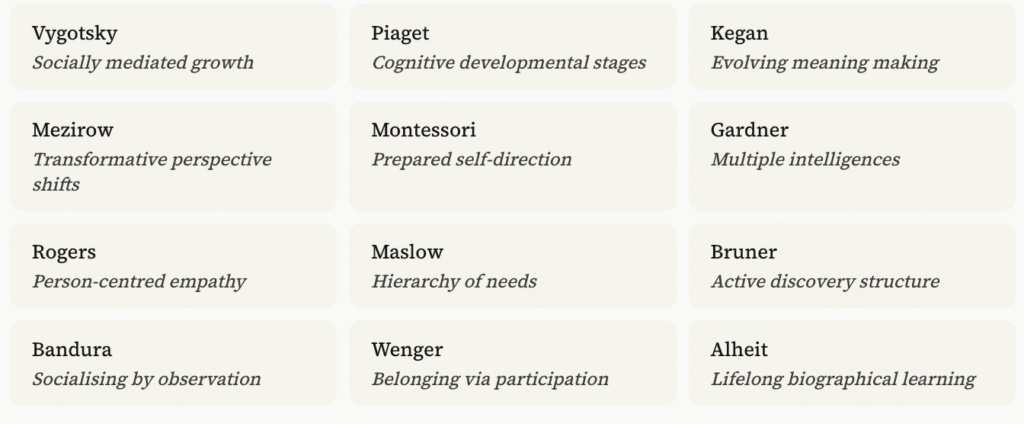
What the BrainPrint framework adds is a way to place each of these perspectives onto a dynamic terrain — not a static chart of learning styles, but a living map that shows where a student or cohort currently sits, what forces are acting on them, and in which direction they are moving. The theorists become navigational tools rather than labels.
The Learning engine: learning as implementation
Central to BrainPrint’s approach to education is the principle that learning is not complete when knowledge is stored. It is complete when knowledge changes behaviour. When the internal cognitive map results in a measurable shift in how a person acts in the world.
This reframes the teacher’s role entirely. The teacher is no longer a broadcaster of content — managing transmission, assessing retention. The teacher becomes a facilitator of deployment. The question shifts from “did the student understand?” to “did the student act differently as a result?” That is a far harder question. It is also the only one that matters.
Our BrainPrint principles operate across three temporal registers that every good educator already uses intuitively, but rarely makes structurally explicit:
Hindsight
BrainPrint @2026
The student understands how they have previously approached learning — their patterns, their defaults, their blind spots.
Insight
The student identifies new pathways — better ways of communicating, collaborating, and encountering difficulty.
Foresight
The student intentionally modulates their energy toward a chosen outcome. Learning becomes generative, not reactive.
The difference between a student who moves through these three registers and one who is stuck in the first — or never reaches the third — is the difference between managed compliance and genuine development. It is, in the end, the difference between education as processing and education as formation.
Significance as the missing variable
The BrainPrint framework introduces a concept that rarely appears in education discourse: significance. Not significance in the statistical sense — but in the existential one. The felt sense that one’s presence, choices, and contributions matter. That the world is different because of what one thinks, makes, or does.
Classroom research applying BrainPrint’s RGB learning model — which maps how individuals deploy energy across a cohort — found something instructive: students who gained awareness of their own learning dynamic, and that of their peers, consistently achieved stronger outcomes than those who did not. Not because they were told more. Because they understood themselves better. Because they became, in the truest sense, agents of their own learning.
This is not a counsel of despair about current education. It is an argument for precision. If we understand the architecture of agency — the specific dimensions along which a person constructs their relationship to meaning, action, and consequence — we can design education that actively develops it. Not as an add-on. Not as a wellbeing programme bolted to the side of a performance-focused curriculum. As the central organising purpose.
What this means in practice
It means designing learning experiences around genuine uncertainty, where the student’s judgment is actually required – not simulated. It means assessment practices that honour divergence, that reward a student for asking a better question, not just providing the expected answer. It means teachers who are trained not only as content experts but as architects of cognitive encounter, who understand that the most important thing they do is not transmit knowledge, but cultivate the disposition to seek it.
The question education must eventually answer is not how to produce better outcomes on existing measures. It is how to produce human beings genuinely capable of authoring their own lives, and contributing, with full presence, to the world they will inherit.
That question has always been at the heart of what education is for. The tools, the theory, and the empirical grounding to answer it better now exist. The remaining question is whether the system has the will to use them.